Last updated June 24, 2026
Garage Door Repair Maintenance Checklist for Miami Homeowners
I’ve pulled garage doors apart that were less than three years old and found rust on the torsion bar deep enough to be a code violation — owners had no idea because they followed a maintenance schedule designed for a dry climate. Miami doesn’t run on four seasons. It runs on a wet season that dumps 45 inches of rain between June and October, a dry season that bakes metal and rubber under relentless UV, and year-round salt air that accelerates corrosion faster than anything else in the country. A checklist built for Chicago or Phoenix will leave your Miami garage door quietly failing. This guide gives you the exact tasks, the right timing, and the Miami-specific details that actually keep your system running.
Quick Answer
A Miami garage door maintenance checklist should follow the dry season / wet season calendar — not spring, summer, fall, and winter. The six most time-sensitive tasks are: lubricating metal components with a high-temp silicone or lithium-based product (not WD-40), inspecting weatherstripping for UV-induced hardening, testing the auto-reverse safety system monthly, checking torsion springs for surface rust every 90 days, clearing the bottom seal and tracks after every significant rain event, and completing a six-point hardware inspection before any named storm enters the Gulf or Atlantic within 72 hours of Miami.
Table of Contents
- Why Miami’s Climate Changes Everything About Garage Door Maintenance
- Month-by-Month Miami Maintenance Calendar
- The Right Lubricants for Miami Heat — and What to Avoid
- How to Inspect Weatherstripping for Florida UV Failure
- The 90-Second Safety Reversal and Force Test
- Pre-Hurricane Season Checklist: Six Hardware Points Before a Named Storm
- Common Mistakes to Avoid
- When to Call a Professional
- Frequently Asked Questions
- The Bottom Line
Why Miami’s Climate Changes Everything About Garage Door Maintenance
Standard garage door maintenance guides assume temperature swings as the primary stress factor — cold contracting metal, heat expanding it, repeat. Miami’s stress profile is completely different. Here, the enemies are humidity, UV radiation, salt air, and standing water, and they work together in ways that destroy a neglected door faster than any freeze-thaw cycle ever could.
Salt air is the issue most Miami homeowners underestimate. If you live east of US-1 — Coconut Grove, Brickell, Key Biscayne, or anywhere in Miami Beach adjacent neighborhoods — your hardware is exposed to marine-grade corrosion conditions. Torsion springs, cables, and track bolts that would last 15 years in an inland climate can show meaningful rust in 18 to 24 months here. We’ve documented this pattern repeatedly on jobs in Coral Gables and South Miami where homeowners were diligent about oil changes on their cars but hadn’t touched the garage door since installation.
UV exposure compounds the problem. Miami receives roughly 3,000 hours of sunlight per year — among the highest in the continental U.S. That UV load degrades rubber weatherstripping and plastic roller bushings at a rate the manufacturers’ standard warranties don’t fully account for. A bottom seal rated for 5 years in a temperate climate may show failure characteristics in Miami within 2 to 3 years.
Then there’s the rainy season. From June through October, Miami regularly sees standing water in garages after heavy afternoon storms. Water pooling against a bottom seal that’s already UV-compromised creates a perfect incubation environment for the kind of accelerated corrosion that voids manufacturer warranties and triggers costly repairs.
Month-by-Month Miami Maintenance Calendar
Forget the four-season model. Miami maintenance runs on two seasons: dry (November through May) and wet (June through October). Here’s the task schedule that actually matches South Florida conditions.
Dry Season (November – May)
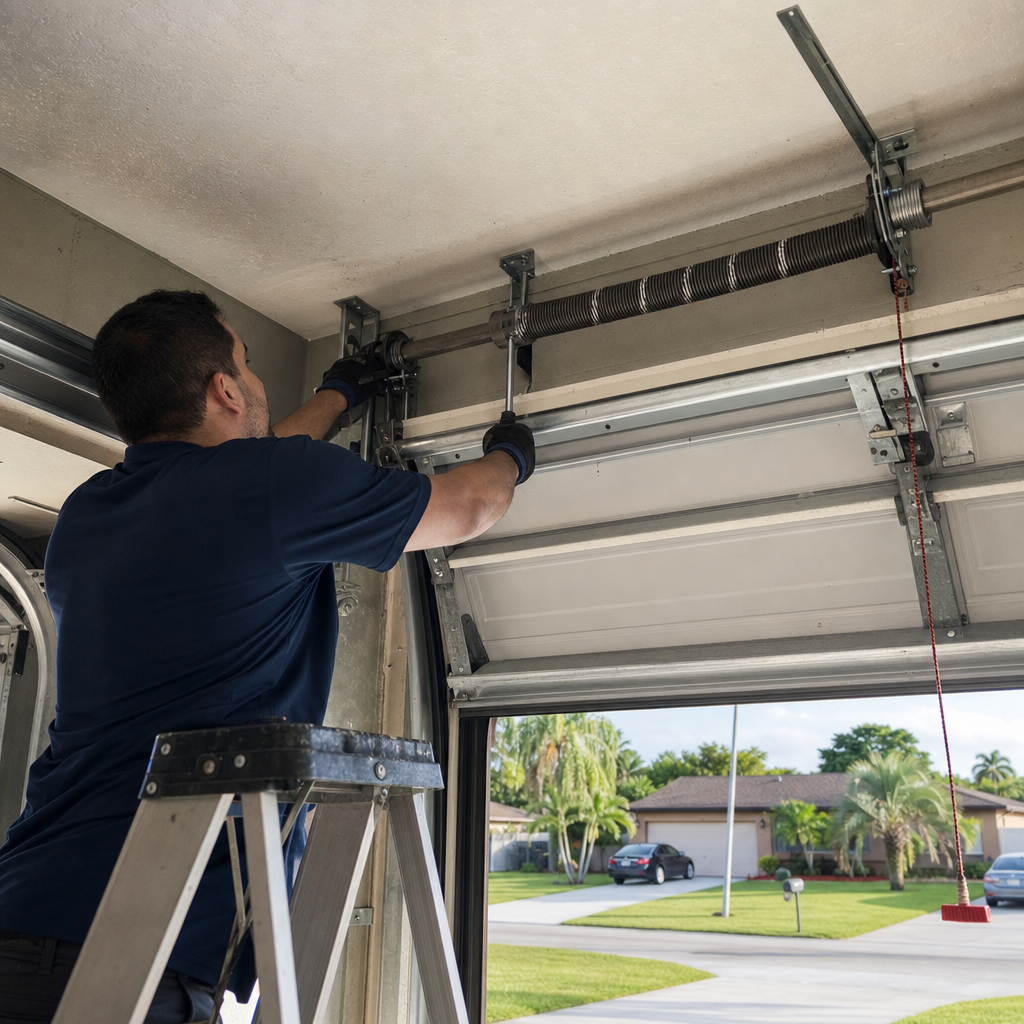
- November — Post-Hurricane Season Inspection: Check all hardware for storm stress. Inspect torsion springs for new cracks or corrosion that developed under wet-season humidity. Test balance by manually lifting the door halfway — it should hold position without drifting. If it drops or rises, the springs need adjustment.
- January — Full Lubrication Service: The dry season is the best time for a thorough lube because humidity is lowest and products penetrate without being diluted by ambient moisture. Hit torsion springs, roller stems, hinges, and the opener’s drive chain or belt.
- March — Safety System Test: Run the full 90-second auto-reverse and force test (see dedicated section below). This should actually be monthly, but March is the mandatory annual baseline before the rainy season adds stress to the system.
- May — Pre-Rainy Season Prep: Replace any weatherstripping showing brittleness. Clear and flush tracks. Inspect cables for fraying. Confirm the bottom seal makes full contact with the garage floor across its entire width. This is your last opportunity before the June–October wet season stress begins.
Wet Season (June – October)
- June — Hurricane Season Opening Check: Complete the full six-point pre-hurricane hardware inspection (detailed below). Check that all lag bolts anchoring the track to the wall framing are tight — water infiltration around frames is common during summer storms and can loosen anchors over time.
- August — Mid-Season Salt and Rust Scan: Wipe down all exposed metal surfaces with a dry cloth, then inspect for surface rust. August heat and humidity peak together — this is when corrosion accelerates fastest. Address any surface rust with a rust-inhibiting primer before it penetrates.
- October — End of Season Full Inspection: Inspect rollers for flat spots or cracked nylon. Check the opener’s safety sensors for alignment drift — heavy rain and wind can shift sensor brackets on older installations. Test the manual disconnect cord to confirm it still disengages smoothly.
The Right Lubricants for Miami Heat — and What to Avoid
This is the section most maintenance guides get completely wrong, and it’s the one that generates the most unnecessary service calls we handle across Miami.
Do not use WD-40 on garage door components in Miami. WD-40 is a water displacer and light solvent, not a true lubricant. In temperatures above 85°F — which Miami hits for eight or more months per year — WD-40 evaporates quickly, leaving a tacky residue that attracts dust and grit. That grit acts as an abrasive on rollers and hinges, accelerating wear rather than preventing it. We’ve opened doors in Kendall and Doral and found roller tracks packed with a black paste that’s essentially WD-40 residue mixed with South Florida road dust.
What to use instead:
- White lithium grease (aerosol): Best for torsion springs, hinges, and roller stems. Stays viscous in high heat, doesn’t drip onto your car, and resists moisture intrusion. Brands like CRC or 3-IN-ONE Professional are widely available at Home Depot locations throughout Miami-Dade County.
- Silicone spray lubricant: Specifically for weatherstripping and rubber bottom seals. Silicone keeps rubber pliable without degrading it. Never use petroleum-based products on rubber — they cause swelling and cracking, which is already a serious risk given Miami’s UV load.
- Garage door-specific chain lubricant: For chain-drive openers like many LiftMaster and Craftsman units, use the manufacturer-specified lubricant. LiftMaster’s white lithium grease is formulated for the operating temperature range of their motor units and works well in Miami’s heat band.
What not to use: Avoid cooking spray, motor oil, or any petroleum-based grease on rollers. In sustained Miami heat, these thicken and gum — and gummed rollers are one of the most common causes of noisy, jerky door operation we diagnose on Garage Door Repair in Kendale Lakes calls and throughout the broader Miami metro.
How to Inspect Weatherstripping for Florida UV Failure
Most guides tell you to look for visible cracks in weatherstripping. That’s useful, but it misses the early-stage failure mode that’s specific to Florida UV exposure — and by the time you can see cracks, the seal has already been compromised for months.
The failure sequence in Miami goes like this: UV radiation breaks down the polymers in rubber and vinyl weatherstripping, causing the material to lose elasticity before it loses structural integrity. The strip looks intact but has hardened to the point where it no longer conforms to floor imperfections or door gaps. Water passes underneath. Insects get in. And the homeowner doesn’t notice until they spot a water stain on the garage floor after a summer squall.
The Pinch Test for UV Hardening
- With the door closed, run your hand along the bottom seal and both side jamb seals.
- Pinch a section of the seal between two fingers and compress it.
- Pass: The material compresses easily and springs back when released. This seal still has elasticity and is doing its job.
- Fail: The material resists compression and feels stiff or brittle, like old plastic. Even if there are no visible cracks, this seal is no longer creating an effective barrier.
- Run a flashlight along the door bottom from inside the garage with the door closed. Any visible light indicates a gap — replace the seal immediately, especially before June.
For doors facing direct west or south sun exposure — common in Miami neighborhoods like Westchester, Hialeah, or Sweetwater where homes are oriented toward prevailing afternoon sun — we recommend inspecting weatherstripping every six months rather than annually. UV degradation is measurably faster on sun-facing installations.
The 90-Second Safety Reversal and Force Test
Every garage door opener sold in the U.S. since 1993 is required to have an automatic reversal system. But the system can drift out of spec over time — and in Miami, thermal expansion of the door panels and humidity-driven changes in floor-level seal compression can push the force settings out of calibration without triggering any obvious symptom. You should run this test monthly. It takes 90 seconds.
Auto-Reverse (Obstruction) Test
- Place a 2×4 piece of lumber flat on the garage floor, centered under the door.
- Close the door using the wall button or remote.
- Pass: The door contacts the board, stops within 2 inches of contact, and reverses upward automatically. This confirms the mechanical reversal system is operational.
- Fail: The door presses against the board and continues to apply force, or reverses only after significant resistance. Stop using the opener and call a technician — this is a crush hazard.
Photo-Eye Sensor Test
- With the door open, wave your hand or foot through the photo-eye beam while pressing the close button.
- Pass: The door stops immediately and reverses.
- Fail: The door continues closing. Check sensor alignment first — Miami’s afternoon thunderstorms can vibrate sensor brackets loose. If realignment doesn’t fix it, the sensors need replacement.
Force Test
- With the door closing, grab the bottom rail with both hands and apply upward pressure — firm but not straining.
- Pass: The door stops and reverses with moderate upward resistance.
- Fail: The door continues downward despite your resistance. The force setting is too high and needs adjustment by a technician.
LiftMaster, Chamberlain, and Genie openers all have force adjustment dials accessible on the motor unit. However, if you’re not familiar with the calibration process, adjusting these incorrectly creates new hazards. Nicholas Flores handles these calibrations routinely — it’s a 15-minute job when done correctly and a recurring problem when done by guesswork.
Pre-Hurricane Season Checklist: Six Hardware Points Before a Named Storm
The Florida Building Code requires garage doors in Miami-Dade County to meet specific wind-load ratings — the result of lessons learned from Hurricane Andrew in 1992. But a door that was code-compliant at installation can develop hardware vulnerabilities over time that compromise its wind performance. When a named storm is within 72 hours of Miami, run through these six points before you lose power or the storm makes inspection unsafe.
- Track anchor bolts: Using a socket wrench, confirm all lag bolts securing the horizontal and vertical track sections to wall framing are tight. Loose tracks are the single most common failure point we see after storm events — a door with even one loose track section can deform under lateral wind load.
- Bottom bracket hardware: The bottom brackets attach the cables to the door’s lowest panel. Inspect both for cracks, bending, or stripped bolt holes. These brackets bear the full cable load and must not show any deformation.
- Cable integrity: With the door closed, inspect both lift cables where they wind around the drums. Look for frayed strands, kinks, or uneven winding. A frayed cable under storm-level door cycling stress will fail suddenly and unpredictably.
- Panel integrity: Walk the door panels and press firmly on each section. Miami’s aluminum-frame single-skin doors — common on homes built before 2000 in areas like Little Havana and Allapattah — can develop hidden dents or buckled seams that compromise panel rigidity. Any panel that flexes more than 1 inch under hand pressure on a wind-rated door should be flagged before storm season.
- Horizontal brace bars: Wind-rated doors have horizontal steel struts across the panel backs. Confirm they’re all present, undamaged, and fully attached at both ends. These are non-negotiable for Miami-Dade wind compliance.
- Manual disconnect and emergency operation: Pull the red emergency release cord and manually lift the door to confirm it operates smoothly without the opener. During a storm, you may need to operate the door without power. If it’s difficult to lift manually, the springs are either underbalanced or the tracks are misaligned — both need correction before the storm arrives.
If you’re considering upgrading to a wind-rated Clopay, Amarr, or Wayne Dalton door before the season, our team can assess your current system and walk you through Garage Door Installation in Kendale Lakes and broader Miami service area options — wind ratings, impact certification, and Miami-Dade product approval numbers included.
Common Mistakes to Avoid
- Using a four-season maintenance schedule: Following a spring/summer/fall/winter checklist in Miami means you’re timing major inspections to seasons that don’t apply here. You’ll lube in winter when you should be prepping for June, and miss the pre-hurricane window entirely.
- Spraying WD-40 on springs and rollers: As covered above, WD-40 in Miami heat leaves a grit-attracting residue. We see this mistake constantly on service calls across Miami — doors that were “just lubricated” that sound like a grinding machine because the wrong product was used.
- Ignoring torsion spring surface rust: A few rust spots on a torsion spring look minor. In Miami’s salt-air environment, that surface rust can penetrate to the spring’s core within one rainy season. A spring that breaks under tension is a serious safety hazard — torsion springs store significant energy. Inspect springs every 90 days, not once a year.
- Skipping the photo-eye sensor wipe-down: Miami’s afternoon thunderstorms leave mineral deposits and dust on sensor lenses. A partially obstructed sensor can cause intermittent reversal behavior that looks like an opener malfunction. Wipe both sensor lenses with a soft cloth monthly — it takes 10 seconds and eliminates a common false-positive repair call.
- Not testing manual operation before hurricane season: Every year after a storm, we take calls from Miami homeowners who can’t get their cars out because the power is out and they’ve never used the manual disconnect. Test it. Know where the cord is. Practice disconnecting and reconnecting before you need to do it in the dark.
- Replacing only one spring on a two-spring system: If one torsion spring breaks, the other is at or near the same age and wear point. Replacing only the broken one leaves you with a spring failure repeat within months. Replace both simultaneously — the labor cost difference is minimal, and the second spring’s remaining life is already compromised.
- Overlooking opener sensitivity drift on Genie and Craftsman units: Older Genie and Craftsman openers in particular can drift in their force and travel limit settings as the drive mechanism wears. If your door is running slightly past the fully closed position, leaving a gap at the floor, don’t adjust the travel limits yourself without understanding the full calibration sequence — incorrect adjustment can create a reversing door that won’t hold closed, which is a security issue.
When to Call a Professional
Some garage door tasks are genuinely DIY-friendly: wiping sensor lenses, applying lubricant, replacing a remote battery, running the safety reversal test. These are maintenance, and you should do them yourself on the schedule above.
Call a professional immediately for any of these situations:
- A torsion or extension spring has snapped, is visibly cracked, or shows deep rust pitting
- A cable is frayed, kinked, or has jumped off the drum
- The door fails the force test or auto-reverse test
- The door is off its tracks or a panel is visibly buckled
- The opener is making grinding, clicking, or straining sounds that weren’t there before
- The door doesn’t hold in the halfway-open position when you test balance manually
- Any hardware inspection before a named storm reveals a problem you can’t immediately correct
Springs and cables under tension carry enough stored energy to cause serious injury when handled without the right tools and training. Nicholas Flores has diagnosed and repaired every failure type on this list across 18 years of Miami field work — this isn’t a task to hand to a generalist handyman. Emergency Garage Door Specialists Miami offers free estimates throughout Miami — call (866) 780-5696 and we’ll tell you exactly what you’re dealing with before you commit to anything.
Frequently Asked Questions
How often should I lubricate my garage door in Miami?
Lubricate torsion springs, roller stems, and hinges every six months at minimum — ideally in January during the dry season and again in July. Miami’s humidity and heat burn through lubricant faster than in drier climates, so a twice-yearly schedule keeps metal-on-metal contact protected. Use white lithium grease, not WD-40. Call (866) 780-5696 if you want a technician to handle it as part of a full tune-up.
How do I know if my garage door springs need replacement in Miami?
Signs include: the door feels heavy when you lift it manually, the door doesn’t stay in the halfway-open position, you hear a loud bang (the spring snapping), or you see visible gaps in the spring coil. In Miami’s salt-air environment, surface rust that starts at the spring’s outer edge can compromise the spring’s integrity well before it snaps — inspect springs visually every 90 days. Spring replacement is not a DIY job; call (866) 780-5696 for a free estimate.
What garage door opener works best in Miami’s heat and humidity?
Belt-drive openers — like LiftMaster’s 8550W and Chamberlain’s equivalent models — handle Miami’s heat cycle better than chain drives because they have fewer exposed metal contact points to corrode and run quieter as thermal expansion shifts tolerances. For homes without air-conditioned garages in areas like Hialeah or Miami Gardens, look for a unit with a thermal protection feature that prevents motor overload on days above 95°F. We stock and service all major brands — call us to match the right opener to your door weight and cycle frequency. Garage Door Opener in Kendale Lakes and the broader Miami service area are covered.
Is a Miami garage door that won’t fully close a safety issue?
Yes — a door that doesn’t seal fully at the floor is a security vulnerability, a weather vulnerability during rainy season, and in some cases a sign of an auto-reverse system that’s overcalibrated. First check that no debris is blocking the photo-eye sensors, then inspect the floor seal for hardening that might be triggering the reversal. If the door stops consistently at the same point above the floor and sensor/seal checks out, the travel limit or close-force setting needs professional calibration. Don’t ignore it — call (866) 780-5696 for a free assessment.
How much does a garage door tune-up cost in Miami?
A professional garage door tune-up in Miami typically runs between $85 and $175, depending on whether the technician lubricates only or also adjusts spring tension, realigns tracks, and recalibrates opener settings. That price range covers a standard single or double door in normal operating condition. If the inspection reveals worn rollers, frayed cables, or corroded springs needing replacement, parts and labor are additional. Call (866) 780-5696 — estimates are free and we’ll walk you through exactly what your system needs before any work begins.
What should I do to my garage door before a hurricane hits Miami?
Complete the six-point hardware inspection detailed above: check track anchor bolts, bottom bracket integrity, cable condition, panel rigidity, horizontal brace bars, and manual disconnect operation. If your door doesn’t carry a Miami-Dade wind-load product approval, consider temporary hurricane bracing kits available at local home improvement stores — but recognize these are not a substitute for a code-rated door. Never use your garage door as a primary hurricane barrier if it’s not rated for it. If you’re uncertain about your door’s wind rating, call us before the storm window closes — (866) 780-5696.
The Bottom Line
A Miami garage door that’s maintained on a generic four-season schedule is one bad rainy season away from a failed spring, a compromised cable, or weatherstripping that stopped sealing before you noticed. The checklist in this guide is built around the conditions that actually affect South Florida doors: UV-driven rubber degradation, salt-air corrosion, tropical humidity, and hurricane-force wind loads. Run the monthly safety tests. Follow the dry-season / wet-season calendar. Use the right lubricants. Inspect weatherstripping with the pinch test, not just your eyes. And know which jobs belong to a professional before a failure forces the decision for you.
With 543 verified reviews averaging 4.7 stars and 18 years of Miami field experience, Nicholas Flores and the team at Emergency Garage Door Specialists Miami have diagnosed every failure mode described on this page — and corrected most of them the same day. When your door needs more than maintenance, call (866) 780-5696 for a free estimate. We serve all of Miami-Dade County, and we pick up.
Written by Nicholas Flores, Owner & Lead Technician at Emergency Garage Door Specialists Miami, serving Miami since 2008.